




Research Experience at WashU
Division of Nephrology, Department of Medicine, Washington University in St. Louis
Nephrology and Hypertension, Department of Internal Medicine, The Jikei University School of Medicine
Kenji Matsui
I am sincerely grateful for the opportunity to conduct research in the laboratory of Dr. Benjamin D. Humphreys in the Division of Nephrology at Washington University in St. Louis (WashU), with support from the International Leading Research Program, “Creating a Kidney.”
Why I Chose to Study Abroad
During my PhD training at The Jikei University School of Medicine under the supervision of Dr. Takashi Yokoo, I worked on kidney regeneration and xenotransplantation. As I completed my PhD, I became eager to broaden my perspective and continue my research in an international environment.
In choosing a host lab, I hoped not only to deepen my work in nephrology but also to gain practical experience in new approaches such as single-cell and spatial transcriptomic analyses. Since beginning my work in the United States, I have been greatly inspired by the pace of research, the diversity of the scientific community, and the strong sense of independence with which researchers pursue their work.
Current Research
At WashU, I am currently studying failed-repair proximal tubule cells (FR-PTCs), which appear after kidney injury and are thought to play an important role in the transition from acute kidney injury (AKI) to chronic kidney disease (CKD). By combining cell culture, mouse models, RNA sequencing, epigenomic analyses, and proximity-dependent proteomic approaches, I am working to better understand the molecular mechanisms that regulate this process.
Dr. Humphreys is a world leader in this field and has made major contributions to our understanding of kidney repair and fibrosis through the use of single-cell technologies. The opportunity to pursue research in his laboratory is therefore of tremendous significance to me.
I have also begun a collaborative project based on a novel apoptosis-inducible mouse model established at Jikei University with Dr. Shuichiro Yamanaka. It has been especially meaningful to lay the foundation for collaboration between Jikei University and WashU.
Research Environment
The research environment at WashU has been highly stimulating. The Humphreys lab includes members from diverse backgrounds, including the United States, Canada, India, China, and Japan, and I have learned a great deal not only from research discussions but also from daily interactions. Since my arrival in the United States, Dr. Humphreys and the lab members have always been supportive and welcoming, which has allowed me to focus on my research with confidence. I also appreciate the strong support system at WashU, including excellent core facilities and many opportunities to attend seminars by internationally renowned scientists.
Life in St. Louis
St. Louis has also been a very comfortable place to live, offering a relatively affordable and calm environment for research and family life. Before coming here, I had some concerns about safety, but in reality I have found the suburban areas peaceful and easy to live in. The city also offers many family-friendly places, such as parks, museums, and the zoo.
Another valuable part of this experience has been meeting other Japanese researchers. Building friendships and supporting one another in a foreign country has created strong bonds, which I consider one of the most meaningful aspects of living and working abroad.
Looking Ahead
I believe that this research stay will become an important foundation for my future career. Through this experience, I hope to contribute to the advancement of nephrology research and, in the future, to support younger researchers as well.
Finally, I would like to express my heartfelt gratitude to everyone who made this opportunity possible, and especially to my wife, who has supported me throughout this journey and shared both the challenges and joys of life abroad with me.
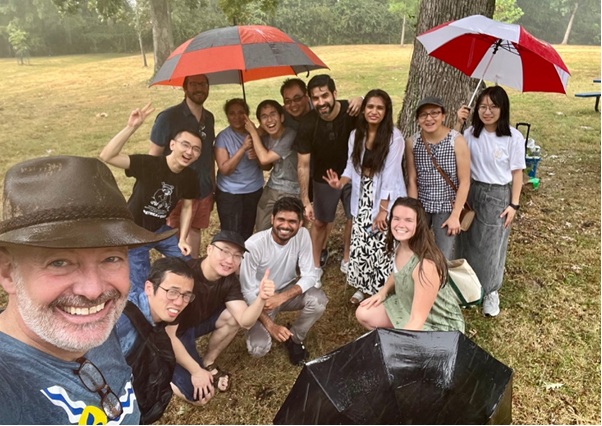
A lab BBQ that was suddenly interrupted by heavy rain became an unforgettable memory.